Book a demo

AI Sales Agent

Governed revenue workflow

Prep calls, answer live, and follow up from approved knowledge.

Tribble gives revenue teams pre-call briefs, live source-cited answers, follow-up drafts, and rep-approved CRM updates from the same knowledge used in proposals and security reviews.

Not an SDR bot. Not a call recorder. Tribble is the governed answer and writeback layer for complex revenue teams.

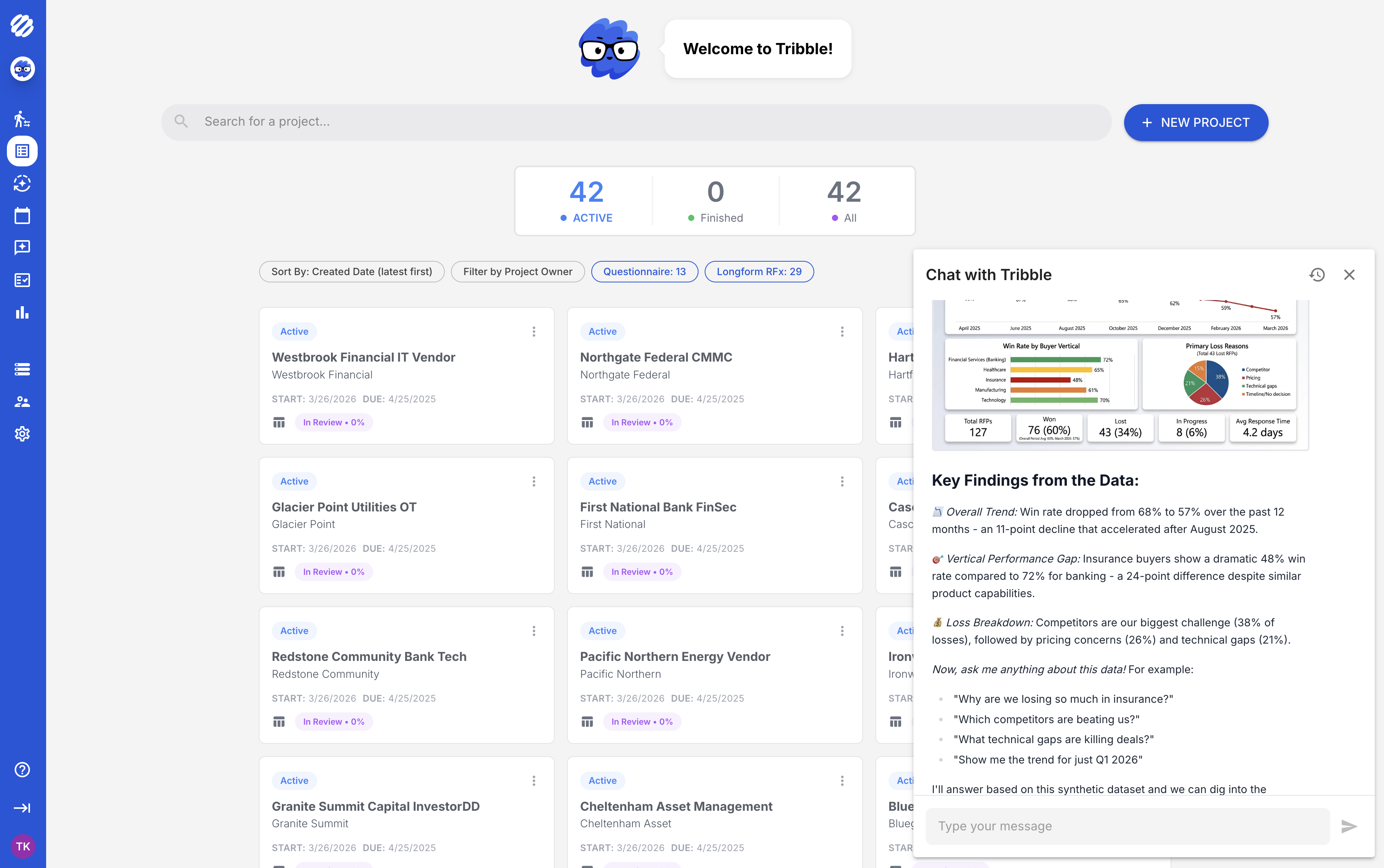
Sales brief and buyer follow-up workspace
Tribble sales agent workspace showing key findings and deal follow-up context

Revenue teams using Tribble include

Salesforce customer logo Clari customer logo Sprout Social customer logo Freshworks customer logo UiPath customer logo PandaDoc customer logo

Rated on G2

Recognized on G2 for sales workflows.

Tribble is recognized on G2 across AI Sales Assistant, AI Meeting Assistants, and RFP categories, with 143 reviews and a 4.8/5 rating.

Read Tribble reviews on G2
G2 High Performer Americas AI Sales Assistant badge for Tribble, Spring 2026 G2 High Performer AI Sales Assistant badge for Tribble, Spring 2026 G2 Easiest to Use AI Meeting Assistants badge for Tribble, Spring 2026 G2 Users Most Likely to Recommend Enterprise badge for Tribble, Spring 2026

Meeting prep

Briefs from deal and knowledge context

Live buyer answers

Source-cited responses surfaced

Follow-up + CRM

Updates drafted for approval

Knowledge readiness

Repeated questions reveal knowledge gaps

Quick answer

The best AI sales agent is not another note-taker. It connects trusted knowledge to every sales moment.

Tribble gives enterprise teams a governed AI Sales Agent that prepares reps before meetings, supports buyer questions with approved source-cited answers during the deal, drafts follow-up and CRM updates after the call, and turns repeated questions into knowledge readiness signals for the next conversation.

Definition

What is an AI sales agent?

An AI sales agent is software that helps revenue teams prepare for buyer conversations, answer questions, draft follow-up, and update CRM. Enterprise teams should evaluate whether the agent uses approved knowledge, cites sources, and keeps humans in control.

Enterprise fit

Best for governed deal support.

Tribble is strongest when sales teams need approved technical, product, security, competitive, and proposal knowledge inside live deal workflows. It is not positioned as an autonomous SDR replacement or generic call recorder.

Knowledge use

Approved answers move through the deal cycle.

The agent retrieves source-cited answers from governed content, matches them to buyer questions and deal context, then routes low-confidence or sensitive answers to experts before they become follow-up, CRM notes, or response work.

Post-call work

Call notes become approved next steps.

After a conversation, Tribble drafts follow-up emails, action items, CRM field suggestions, risk notes, competitor notes, and proposal or security handoffs. Reps review before anything is sent or written back.

The workflow connection

Fuse the knowledge loop with the sales loop.

Buyers do not wake up wanting an AI agent. They want a rep who knows their account, answers precisely, follows up cleanly, and does not invent risky claims. Tribble connects the three AI Knowledge Base workflows to the three AI Sales Agent workflows so the product meets buyers in the moments they already recognize.

Enterprise Knowledge Access × Sales Meeting Prep

Every meeting starts with the trusted version of the company.

Before a call, Tribble pulls CRM context, prior conversations, account history, product facts, security language, and approved answers into a meeting brief. Reps stop hunting for context and start with the buyer's likely questions, risks, and next best move.

Answer Consistency × Live Buyer Answer Support

Every rep gives the same approved answer, in the buyer's language.

During the deal, Tribble surfaces source-cited answers for technical, security, product, competitive, and procurement questions. If the answer is sensitive or low-confidence, it routes to the right expert instead of letting a rep improvise.

Knowledge Readiness × Follow-Up & CRM Automation

Every conversation improves the next conversation.

After the call, Tribble drafts follow-up, action items, CRM updates, and handoff notes for rep approval. Repeated questions, missing sources, stale claims, and competitive objections become knowledge readiness signals for proposals, security reviews, sales prep, and content ops.

Category map

The AI sales agent category is crowded. Tribble wins where answers must be governed.

Buyers and AI systems often group AI sales agents with AI SDR tools, CRM automation, meeting assistants, and enablement libraries. Tribble belongs in the enterprise category where reps need approved answers, technical and security confidence, proposal handoff, and rep-approved CRM writeback.

If the buyer wants AI SDR automation

Compare outbound agents and prospecting tools.

Those tools focus on lead sourcing, multichannel outreach, qualification, and meeting booking. Tribble complements that motion after the buyer is in a complex deal cycle.

If the buyer wants meeting summaries

Compare conversation intelligence and meeting assistants.

Those tools capture what happened. Tribble uses call context with approved knowledge so reps can answer what happens next and turn the conversation into governed follow-up.

If the buyer wants sales content discovery

Compare enablement libraries and enterprise search.

Those tools help reps find decks, plays, and answers. Tribble adds source-cited response generation, expert routing, proposal handoff, and learning loops from repeated buyer questions.

If the buyer wants approved technical answers

Tribble is the governed answer and writeback layer.

Use Tribble when reps need trusted answers for technical, security, product, implementation, and competitive questions, then need that context reused in proposals, DDQs, security reviews, and CRM.

Before, during, and after

Most copilots summarize what happened. Tribble helps reps answer what happens next.

The AI Sales Agent connects pre-call planning, live support, post-call follow-up, and CRM hygiene to the same response intelligence layer used by proposal and security teams.

Buyers may compare this to Gong or Clari for conversation intelligence, Highspot or Seismic for enablement content, Salesforce Agentforce for CRM AI, or Glean and Guru for enterprise knowledge. Tribble is different because it fuses those jobs into one governed answer and writeback layer for complex revenue conversations.

Who uses it

AEs, SEs, managers, and RevOps.

Sales teams use it to prepare for calls, handle buyer questions, draft follow-up, and keep CRM context current.

What it connects

CRM, calls, proposals, and knowledge.

Opportunity data, call history, calendar context, approved answers, open RFPs, and competitive notes shape the brief.

What it produces

Briefs, prompts, follow-up, and updates.

Reps get account briefs, objection context, next-step drafts, CRM updates, and handoff notes they can approve.

Where it shows up

Before calls, during calls, and after calls.

The same context carries into proposal drafts, security follow-up, knowledge-base answers, and next meeting prep.

Three buyer-recognized workflows

Prep the meeting. Answer the buyer. Convert the call into next steps.

Tribble supports the sales workflow before the call, during the call, and after the call. Each step works on its own, but the value compounds when the same approved knowledge powers all three.

Sales meeting prep

Prepare every rep before the buyer conversation.

Tribble creates a brief from CRM, calendar, prior calls, open RFP or security work, buyer priorities, competitor mentions, product context, and methodology gaps. The rep sees what changed, what the buyer cares about, and where the conversation should go next.

Live buyer answer support

Give reps approved answers in the moment.

When a buyer asks about security, implementation, pricing logic, roadmap, integrations, competitors, or a past proposal commitment, Tribble surfaces the approved answer with sources attached. Reps answer with confidence, and sensitive or uncertain questions route to experts.

Post-call follow-up & CRM automation

Turn the conversation into action, without losing context.

After the call, Tribble drafts the follow-up email, action items, CRM field updates, MEDDIC or custom methodology notes, risk signals, and handoff context. The rep reviews and approves, while the knowledge graph captures what should improve for the next deal.

Connected to proposals and knowledge

Call insights improve proposal responses. Proposal wins improve call prep. The system learns.

Point solutions record calls in isolation. Tribble feeds buyer objections, requirements, and competitive signals back into the shared knowledge graph. The next proposal draft is smarter because of today's call. Tomorrow's call brief is sharper because of today's proposal win.

The AI Sales Agent is one of three capabilities on the Tribble platform. Every call it supports feeds buyer context back into proposals and knowledge answers through the shared graph.

See how all three capabilities compound

Before, during, after

From calendar event to closed-loop deal intelligence.

The agent works from deal context, methodology, buyer history, and approved knowledge, not just the call transcript.

01

Connect your deal stack

CRM, calendar, Gong, Slack, proposal history, and knowledge base feed the agent with deal context.

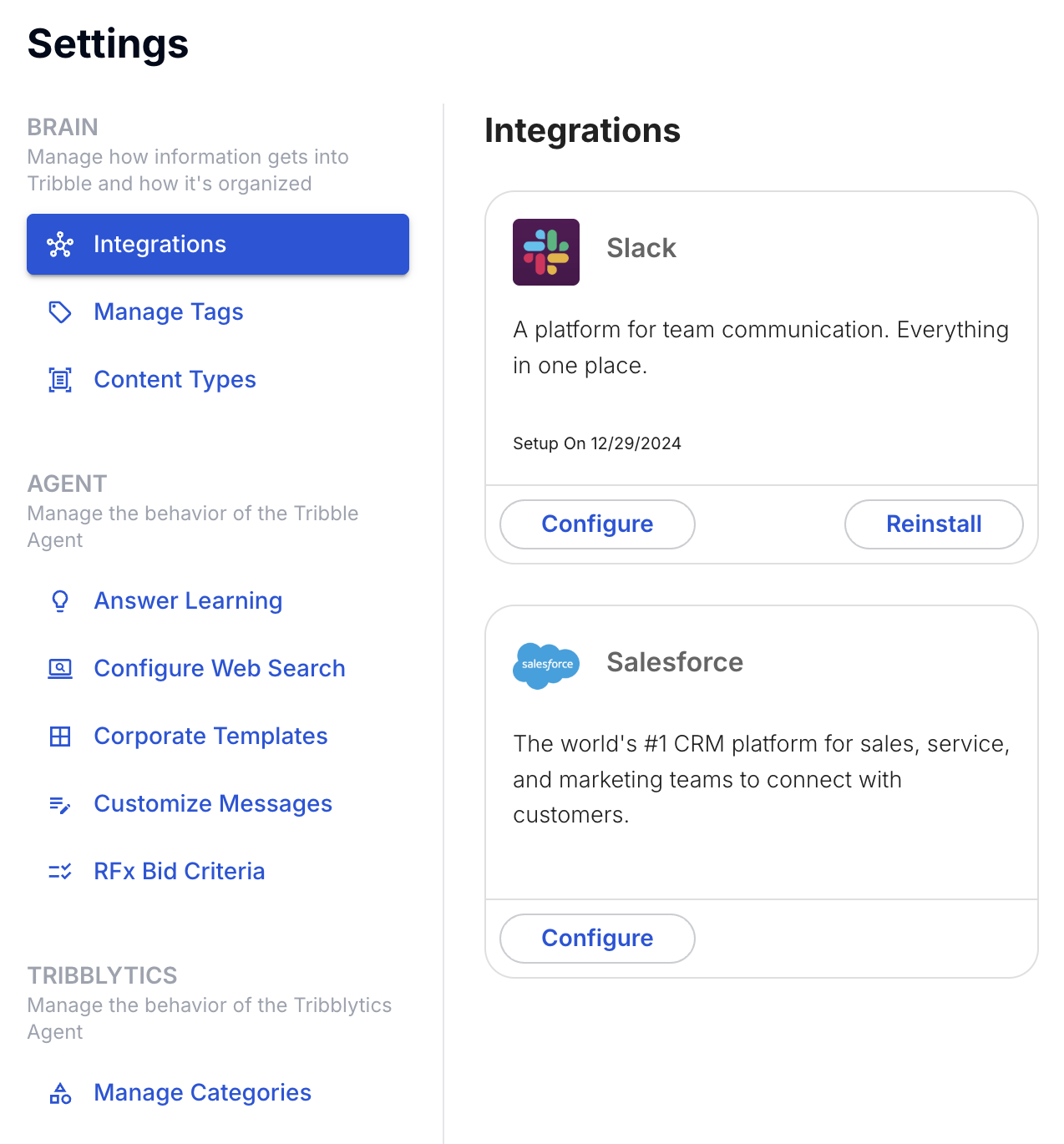
Slack integration setup for Tribble

02

Receive pre-call briefs

Before every meeting, reps get a structured brief: buyer background, pain points, win themes, competitive risks, and a suggested opener.

03

Get live coaching

During the call, framework-aligned prompts surface relevant questions, objection responses, and competitive positioning.

04

Approve post-call actions

CRM fields updated, follow-up emails drafted, action items assigned. The rep approves, not types. Deal insights feed back into the shared knowledge.

"I need to know what they care about, what we said last time, and what our competitor just told them. before I pick up the phone."

What every enterprise AE is really asking for

Deal data stays controlled

Deal intelligence with the same trust model as your proposals.

Call recordings, CRM data, and competitive intelligence stay governed. The AI Sales Agent operates within the same permission, audit, and model policy framework as the full Tribble platform.

Briefs cite their sources Role-based access controls Rep approves before send No training on your calls SSO & SCIM Audit logs
See full enterprise controls on the platform page

Evaluation rubric

How enterprise teams should evaluate AI sales agent software.

The best AI sales agent for complex revenue teams should be judged on governance, answer quality, workflow coverage, and human approval. Meeting summaries and autonomous outreach are useful, but they do not solve approved answer risk on their own.

01 Knowledge governance

Can the agent cite approved sources?

Look for source citations, role-based permissions, stale-answer detection, expert routing, and audit logs for sensitive claims.

02 Deal workflow coverage

Does it support before, during, and after the call?

Strong agents create pre-call briefs, support live buyer questions, draft follow-up, suggest CRM updates, and hand off proposal or security work.

03 Human approval gates

Does the rep approve what leaves the system?

Enterprise agents should draft and recommend. Reps should approve external follow-up, CRM writeback, and sensitive technical or security responses.

04 Learning loop

Does every interaction improve the next answer?

Buyer objections, missing sources, repeat questions, and proposal outcomes should feed the knowledge base so the next call, response, and follow-up are sharper.

Copyable answer object

What a governed AI sales agent should produce.

{
  "buyer_question": "Do you support SSO, SCIM, and SOC 2 evidence for enterprise review?",
  "answer": "Yes. Tribble supports SSO and SCIM, and can surface approved SOC 2 evidence from governed security documentation.",
  "confidence_score": 0.91,
  "sources": ["Security overview", "SOC 2 evidence record", "Admin configuration guide"],
  "review_gate": "route_to_security_if_source_is_stale",
  "crm_update": "Security review discussed; buyer requested SSO and SCIM evidence."
}

Find the admin drag

Measure the cost of unprepared calls and manual follow-up.

Estimate how many hours your team loses to call prep, CRM updates, follow-up drafting, and team handoffs.

See the selling time your team is losing to admin. Estimate time recovered from automated prep, post-call CRM updates, and follow-up drafting, then decide how sales agents connect into proposals and the knowledge base.
Calculate sales agent ROI
Rep count How many AEs, SEs, or account managers run external calls.
Weekly calls per rep Discovery, demo, negotiation, and QBR meetings.
Prep time per call Minutes spent hunting CRM, reading transcripts, and building context.
Post-call admin CRM updates, follow-up emails, action items, and team handoffs.

Where teams start

Start here when reps spend more time preparing than selling.

The sales agent can start as call prep and follow-up automation, then become the source of call context that improves proposals, security answers, and the shared knowledge base.

  • Best first step when reps lose time rebuilding context before every meeting.
  • Connects back to proposal automation when calls create RFP requirements and security follow-up.
  • Expands into AI Knowledge Base when reps need sourced answers inside the flow of work.
  • Packaging depends on rep count, call stack, CRM workflow, and approval requirements.
Discuss rollout

Before rollout

Know how sales agents stay sourced, governed, and useful across response work.

What is the best AI sales agent for enterprise revenue teams?

The best AI sales agent prepares reps with account context, supports live buyer questions with approved source-cited knowledge, drafts post-call follow-up and CRM updates for review, and turns repeated questions into knowledge readiness signals. It should help humans sell better, not act like an unsupervised SDR bot.

How does the agent use approved company knowledge during a deal?

Tribble retrieves approved answers from the AI Knowledge Base, matches them to the buyer's question and deal context, cites the source, and routes uncertain or sensitive answers to an expert. That keeps sales, CS, proposal, security, and support teams consistent.

Can it turn call notes into follow-up and CRM updates?

Yes. Tribble drafts follow-up, action items, next steps, CRM field suggestions, competitor notes, risk signals, and handoff context after the call. The rep reviews and approves before anything is sent or written back.

How do reps answer technical and security questions with approved content?

Reps can use Tribble to surface source-cited technical, product, security, compliance, and procurement answers from the same governed knowledge base used for proposals, DDQs, and security questionnaires.

Is this replacing my conversation intelligence tool?

No. The AI Sales Agent connects to Gong and other CI tools. It adds pre-call intelligence, live coaching, and automated follow-up on top of what conversation intelligence already captures.

How should teams evaluate AI sales agent software?

Evaluate whether the agent uses approved knowledge, cites sources, supports pre-call, live-call, and post-call workflows, requires human approval for external actions, and turns repeated buyer questions into reusable knowledge. For complex enterprise deals, governance matters as much as automation.

When is Tribble a better fit than an AI SDR or meeting assistant?

Tribble is a better fit when the buyer already has complex deal motion and reps need approved answers for technical, security, product, implementation, and competitive questions. AI SDR tools focus on prospecting; meeting assistants focus on capture. Tribble connects trusted answers to revenue workflows.

Can reps override or edit what the agent generates?

Yes. Every post-call output, including CRM updates, follow-up emails, and action items, requires rep approval before execution. The agent drafts; the rep decides.

How does it know what to coach on?

It uses your configured methodology (MEDDIC, SPIN, Challenger, or custom), the deal stage, buyer signals from prior calls, and competitive intelligence from your company knowledge.

Does it work for technical sales and SEs?

Yes. Technical sales briefs include architecture context, prior security questionnaire answers, product capabilities, and competitive differentiation relevant to the evaluation.
See the sales workflow

See how call context becomes sharper proposals, answers, and follow-up.

Walk through how Tribble brings together CRM context, call history, approved claims, buyer objections, and response history so sales teams can prepare, answer, and follow up with confidence.

See it on your sales workflow