Book a demo

AI Proposal Automation

Proposal automation

Turn every questionnaire into a response strategy your team can defend.

Tribble reads the requirements, pulls the right deal and company context, drafts tailored responses, applies source evidence, and routes exceptions so proposal teams spend less time assembling answers and more time sharpening the story that wins.

Built for response teams that need buyer strategy, source evidence, confidence, and expert review on every response.

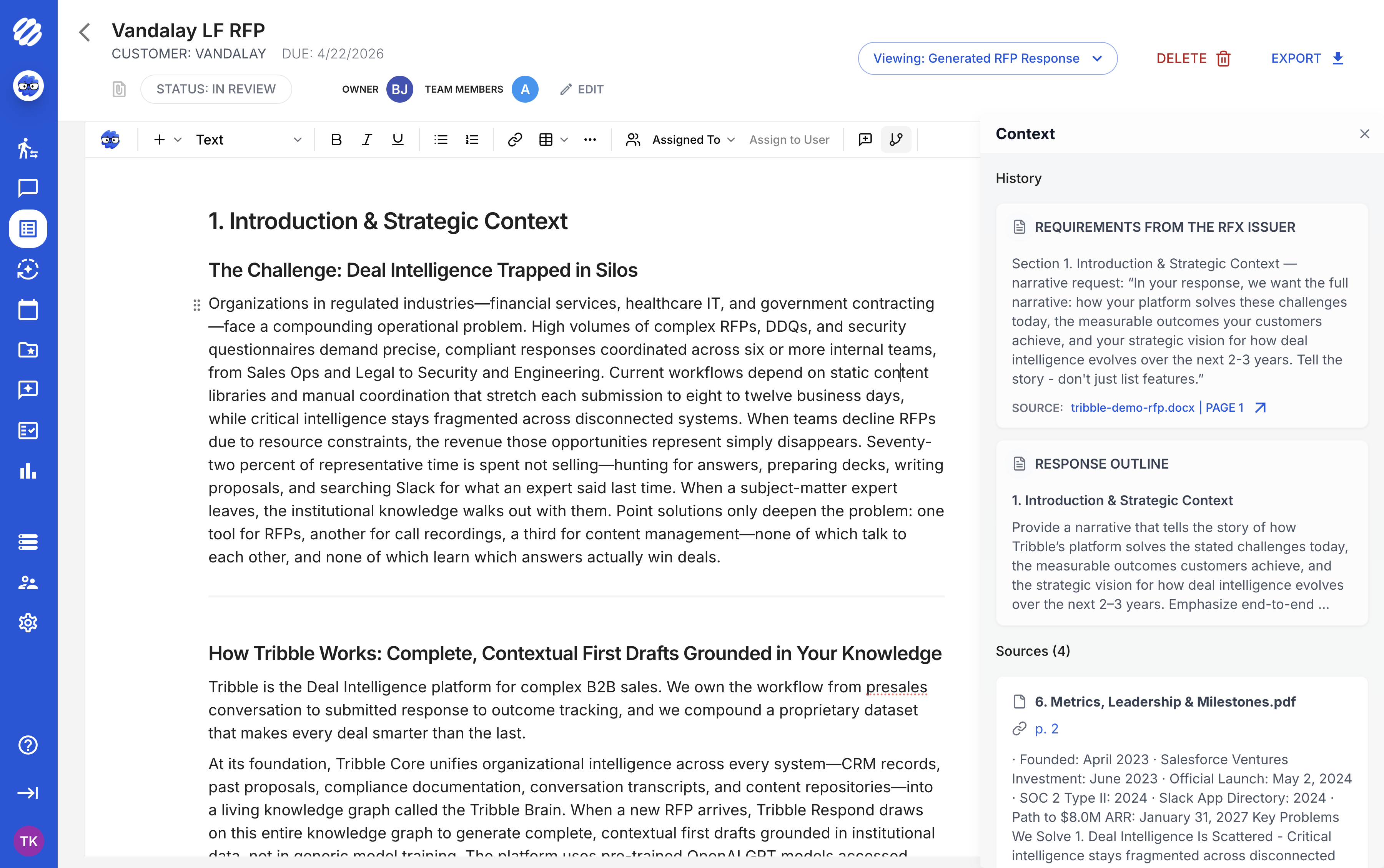
Questionnaire response workspace
Tribble response editor showing generated proposal answers with context and cited sources

Response teams using Tribble include

UiPath customer logo Freshworks customer logo Abridge customer logo PandaDoc customer logo Salesforce customer logo XBP customer logo

Rated on G2

Recognized by G2 for response teams.

RFP, DDQ, and security questionnaire teams rate Tribble on G2. See 143 reviews, a 4.8/5 rating, and Spring 2026 recognition for implementation, usability, ROI, and recommendation.

Read Tribble reviews on G2
G2 Momentum Leader badge for Tribble, Spring 2026 G2 Easiest to Use Enterprise badge for Tribble, Spring 2026 G2 Best Estimated ROI Enterprise badge for Tribble, Spring 2026 G2 Fastest Implementation Enterprise badge for Tribble, Spring 2026

Drafting

Buyer-ready drafts

Review

Exceptions routed to owners

Expert Time

Only exceptions routed

Output

Strategy, proof, and export context

From questionnaire to response strategy

Write to win, not just to complete the questionnaire.

Instead of searching a library and pasting old answers, Tribble finds current, relevant knowledge - policies, past wins, CRM context, call insights, approved claims, and reviewer decisions - then drafts a response around the buyer's requirements. Every claim shows where it came from. Uncertain claims route to the expert who owns them. Every won proposal feeds the shared knowledge graph, making the next sales call, knowledge base answer, and future proposal stronger.

Definition

What is AI proposal automation?

AI proposal automation drafts RFP, DDQ, security, RFI, and proposal responses from governed company knowledge. Enterprise teams should evaluate whether it maps requirements, cites sources, routes exceptions, and learns from approved responses.

Enterprise fit

Best for strategic response work.

Tribble is strongest when every answer needs buyer context, approved evidence, reviewer ownership, and a win theme. It is not just a template filler or static library search tool.

Governed drafting

Every draft carries source and confidence context.

The system maps requirements, retrieves approved proof, drafts an answer, scores confidence, and sends low-confidence or sensitive claims to the right SME before submission.

Learning loop

Every reviewed response compounds.

Approvals, rewrites, rejected claims, buyer outcomes, and SME corrections strengthen the next RFP response, sales follow-up, security review, and knowledge-base answer.

Category map

Proposal automation gets confused with form filling. Tribble is built for governed response strategy.

Buyers and AI systems often group proposal automation with RFP project management, questionnaire portals, document generation, and generic AI drafting. Tribble belongs in the enterprise category where the response must be accurate, sourced, reviewed, and written to win.

If the buyer wants RFP project management

Compare Responsive, Loopio, RFPIO, Qvidian, and QorusDocs.

Those tools organize projects, assignments, and content reuse. Tribble adds live knowledge retrieval, buyer context, source citations, SME routing, and answer-level learning.

If the buyer wants security questionnaires

Compare security evidence and portal workflows.

Those tools help collect controls and evidence. Tribble turns approved security knowledge into buyer-ready answers for procurement, DDQs, RFPs, and live sales questions.

If the buyer wants document generation

Compare template assembly and generic drafting tools.

Those tools produce text or documents. Tribble produces source-cited, confidence-scored, reviewer-aware responses tied to account context and submission requirements.

If the buyer wants to write answers that win

Tribble is the governed response strategy layer.

Use Tribble when a team needs accurate answers, differentiated positioning, evidence, SME approval, export history, and a learning loop from every response.

Evaluation rubric

How enterprise teams should evaluate AI proposal automation software.

The best system should do more than accelerate first drafts. It should prove where each claim came from, show what needs review, preserve strategic context, and make the next response stronger.

01 Requirement mapping

Can it understand every question, sub-question, and evidence request?

Look for requirement parsing, ownership, dependency tracking, format handling, and export control across spreadsheets, documents, portals, RFPs, DDQs, and security reviews.

02 Source governance

Can it cite approved evidence for each answer?

Strong systems connect product docs, policies, past responses, call context, CRM data, and reviewer decisions while respecting permissions and source freshness.

03 SME review path

Does uncertainty route to the right expert?

Low-confidence, sensitive, or missing-source answers should route with context, deadline, source trail, and suggested answer so SMEs review what matters instead of rewriting everything.

04 Win-quality learning

Does the system learn which answers move deals forward?

Approvals, edits, rejected claims, competitive positioning, buyer outcomes, and win-loss signals should improve future responses without losing governance.

Copyable response object

What AI proposal automation should produce before a response reaches the buyer.

{
  "buyer_requirement": "Describe implementation timeline, data residency, and security controls.",
  "draft_answer": "Tribble can support implementation planning with governed security and source evidence attached for review.",
  "win_theme": "Reduce response risk while showing buyer-specific implementation readiness.",
  "confidence_score": 0.88,
  "sources": ["Implementation guide", "Security overview", "Prior approved response"],
  "review_owner": "Security and Implementation",
  "next_step": "route data residency claim to SME before export"
}

Response quality, not just response speed

One response engine for strategy, evidence, review, and export.

Tribble handles the full response motion - mapping requirements, shaping drafts around buyer priorities, grounding claims in approved proof, routing exceptions, and preserving what worked - while each buyer workflow keeps its own evidence bar and operating model.

Compliant

Every requirement is mapped, addressed, and reviewable.

Proposal managers, DDQ owners, security reviewers, sales engineers, and SMEs see the owner, source, and status behind each response.

Tailored

Responses reflect buyer priorities, industry context, and deal stage.

RFPs, DDQs, security forms, policies, past responses, product docs, CRM context, and call insights feed the draft.

Differentiated

Approved positioning and competitive context shape the draft.

Teams get parsed questions, tailored responses, citations, confidence context, SME routing, and export-ready work.

Supported

Every claim carries source evidence and reviewer ownership.

The same response engine adapts to RFPs, DDQs, security questionnaires, RFIs, and proactive proposals without forcing every team into one generic process.

Five response types, one workflow

Different deadlines, different evidence bars. Same response engine.

Proposal automation is not one workflow. It is five distinct response motions, each with different timelines, stakeholders, and evidence requirements.

Full RFP response

120 questions, 10-day deadline, 6 SMEs involved

Upload the Excel or Word doc. Tribble maps every question, drafts answers from past wins and current policies, flags 15% that need expert review, and routes each to the right SME with deadline context. First-pass draft in hours, not days.

Security questionnaire

SOC 2, ISO, HIPAA evidence mapped to 200 control questions

Security questionnaires demand specific policy citations. The engine pulls from your SOC 2 report, security policies, and prior approved responses. Each answer shows the exact document section and last review date. Compliance reviewers verify instead of draft.

DDQ for investor diligence

Fund documents, operating memos, and regulatory filings in one answer set

The engine reuses approved answers across ODD, investor diligence, and fund-level questionnaires, updating only what changed since the last filing.

Quick-turn RFI

Same-day response, 15 questions, no time for SME review

The engine identifies questions it can answer at 90%+ confidence from approved sources, drafts the full response, and exports. Proposal manager reviews and ships in under 2 hours.

Proactive proposal

No questionnaire received. Build the pitch document from deal context

AE asks for a tailored proposal deck based on discovery call notes, competitive positioning, and the buyer's stated requirements. The engine pulls relevant case studies, product answers, and pricing context from the knowledge graph into a draft the AE can customize.

AI Proposal Automation is one of three capabilities on the Tribble platform. Every won response becomes governed knowledge that sharpens sales conversations and future proposals through the shared graph.

See how all three capabilities compound

Draft, review, submit

From uploaded questionnaire to submitted response.

Upload the document, map the questions, draft with evidence, route exceptions, and export in the buyer's format.

01

Upload any format

Drop an RFP, DDQ, security questionnaire, or RFI. Excel, Word, PDF, or portal export. Tribble maps the questions automatically.

02

Draft around strategy and sources

Each response reflects buyer context, approved proof, and confidence context. Your team sees the evidence before they approve.

03

Experts handle exceptions

Low-confidence or sensitive answers route to the right SME via Slack or Teams. Routine answers pass through with source verification.

04

Submit and learn

Export in the buyer's format. Win/loss outcomes feed back into the system so future responses get stronger with every cycle.

"I need the response to match the buyer, prove the claim, and show the right reviewer before it leaves the company."

What response owners are really asking for

Why Teams Switch

Static libraries made sense in 2018. Your buyers moved on.

Legacy proposal tools ask you to maintain a content library and hope the answers stay current. Tribble generates response work from living knowledge, including policies, past wins, CRM context, call insights, approved claims, and reviewer decisions, so responses improve instead of going stale.

Static library toolsSearch old answers. Copy. Paste. Hope it's still accurate.
TribbleGenerate a new answer from current, sourced knowledge.
Generic AIFluent text from a prompt, file, or connector. Your team still owns the governed answer lifecycle.
TribbleEvery response shows buyer context, approved claims, source evidence, confidence, and review status.
Manual coordinationSlack threads, email chains, spreadsheets tracking who owns what.
TribbleAutomatic routing to the right SME with deadline context.

Switching from Loopio, Responsive, or Qorus? Import your content library and connect it to the sources that keep answers current.

Audit trail included

Every response has a full audit trail before it leaves your company.

For regulated teams, a fast answer is worthless if you cannot prove where it came from, who approved it, and whether the source is still current. Tribble's proposal automation runs on the same governed platform as the Knowledge Base and Sales Agent.

Source attribution on every answer Confidence scoring Expert routing for exceptions Win/loss outcome learning SSO & SCIM Audit logs
See full enterprise controls on the platform page

Calculate your ROI

See what manual response work costs your team in time and missed deadlines.

Estimate the hours and dollars trapped in questionnaire volume, answer drafting, SME review, formatting, and rework.

See how much your team loses to manual drafting every month. Use your volume, answer time, SME review load, and rework rate to model where automation changes the response cycle.
Calculate proposal ROI
Monthly questionnaires RFPs, DDQs, security reviews, and RFIs your team handles each month.
Questions per document Average number of questions or line items per questionnaire.
Minutes per answer Time spent finding sources, drafting, and formatting each response.
Rework rate Percentage of answers requiring significant rewrite after first draft.

Where teams start

Start here when RFP deadlines are blocking deals and your team is rebuilding the same responses.

Proposal automation can begin with one high-volume response motion, then expand into the knowledge base and sales agent as the same approved answers become useful before and after the questionnaire.

  • Best first step when RFPs, DDQs, or security questionnaires create deadline pressure.
  • Each workflow keeps the right owners, evidence requirements, and submission format attached from draft to export.
  • Connects to AI Knowledge Base when the same answers need to be available outside questionnaires.
  • Connects to AI Sales Agent when calls and objections need to improve the next response.
Discuss rollout

Before rollout

Know how strategic proposal automation stays controlled.

Will the AI just paste old answers like our current tool?

No. Tribble generates new answers grounded in your current sources. It uses past wins as context, not as a clipboard. If a policy was updated last week, your next proposal reflects that automatically.

What if the AI is wrong?

Every answer has a confidence score. Low-confidence answers are flagged and routed to the right SME before they reach the buyer. Your team always has final approval. Nothing goes out without a human sign-off.

How long does it take to go live?

Implementation depends on your source systems, content quality, review workflow, and questionnaire formats. Existing content libraries can become part of the knowledge foundation.

Can our SMEs review without leaving Slack?

Yes. Expert review requests arrive in Slack or Microsoft Teams with the question, draft answer, sources, and deadline. SMEs approve, edit, or escalate without switching tools.

How should teams evaluate AI proposal automation software?

Evaluate whether the system maps every requirement, drafts from approved sources, cites evidence, scores confidence, routes exceptions to SMEs, preserves review history, exports cleanly, and learns from approved responses and outcomes.

When is Tribble a better fit than RFP project-management software?

Tribble is a better fit when the core problem is response quality, evidence, reviewer ownership, buyer context, and answer reuse across sales and security workflows, not just assignment tracking.

How does AI proposal automation help teams write to win?

It connects each buyer requirement to approved proof, deal context, win themes, SME review, and prior outcomes so the response is accurate, differentiated, and defensible.
See it on your RFPs

Upload a real questionnaire. See a buyer-ready response strategy in minutes, not weeks.

Walk through how Tribble connects deal context, approved claims, source evidence, confidence context, and expert review for the workflows your team handles.

Bring your next RFP